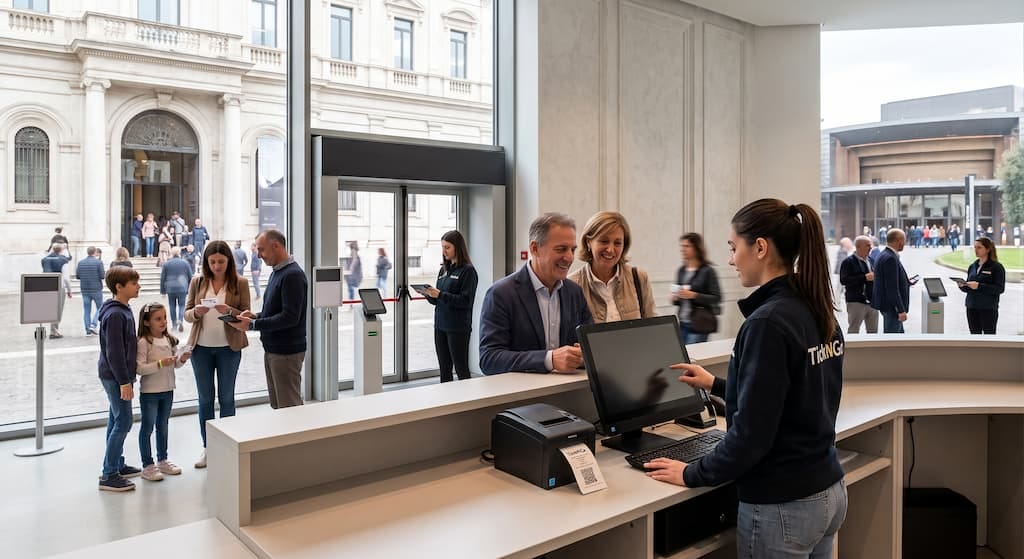
How digital museums work, from the kiosk to the gate

TickNGo, the system connecting tickets and admissions in digital museums
Have you ever got to the end of the day having to check several tools to know how many tickets were sold, how many visitors came in and which extra services were purchased? In digital museums it takes a few seconds to find out.
In many museums, online sales, on-site sales and admission control still run on separate systems that do not communicate with each other, multiply the staff's workload and take time away from caring for the public and the collections. When these operations are instead connected by a single platform, the visitor is followed from booking to the gate and the operators see sales, availability and attendance at every moment.
To understand what changes, let's start from the meaning of the expression and then follow a visitor's journey, from the purchase made at home to the data that remains with the museum at the end of the day.
Two sides of the same transformation: from the exhibition hall to the ticket office
A digital museum is a cultural venue that uses digital tools in two directions: to enrich the visit experience, with multimedia content and audio guides, and to manage tickets, bookings and admissions with interconnected systems.
When people talk about it, they usually think only of the first direction: virtual exhibitions, collections browsable online, interactive installations. It is also the one largely focused on by the Ministry of Culture's National Plan for the Digitisation of Cultural Heritage. For those running a museum, however, the second matters just as much, because it determines how tickets are sold, how long people wait at the entrance and how much time the staff have left for the public.
And it is precisely management that determines the quality of everything else: even the most innovative exhibition loses value if the visit begins with half an hour of queueing.
The visit begins at home, before even setting off
The first contact with the museum increasingly happens on the smartphone, and the ticket office becomes a customisable online store integrated into the website, showing real-time availability and bringing ticket, guided tours, educational activities and audio guides into a single purchase.
Booking an individual visit, however, is different from organising a school trip or the arrival of a tour group, and the system must handle different needs:
- Individual visitors: they choose the time slot and receive the ticket directly on their smartphone.
- Schools: they book admissions for whole classes together with workshops and educational activities.
- Agencies and tour operators: they manage bookings for several groups with vouchers to convert into tickets and services on arrival.
The audio guide in particular requires no devices: after payment the visitor receives a QR code to listen to the content on their own phone, without collecting equipment at the counter, while the museum creates and updates the content independently.
For the museum, all this means knowing from the morning how many visitors are expected, at what times and for which activities: the day is organised starting from certain data, not estimates.
Gate, pedestal or handheld? The right entrance for every digital museum
It is on arrival that an integrated ticketing system truly shows its value. Those who have already purchased online go straight to the entrance or collect the ticket at the self-service kiosk with the pick-up function, while those arriving without a booking buy on the spot, with the same fares and availability as the online store. No wasted steps for visitors, and more calm for the staff at busy times.
Control happens by reading the ticket's QR code, with modes that change according to the spaces, the number of visitors and the layout of the museum. This is why different devices exist, usable alone or together.
The most complete solution is sMove Wave, an access gate with an advanced closing system: a physical barrier that opens only after the integrated reader has validated the ticket. The visitor passes through alone, without a fixed operator checking, but the gate must be installed in a stable position because it needs a data connection and mains power. Where more flexibility is needed there is the Door.Gate Pedestal, a mobile device with a QR code reader that can be placed at the entrance: it does not block the passage, works on Wi-Fi and battery, moves as needed and lets a single operator supervise up to three readers at the same time. The mobile reader, finally, is a handheld device with which the operator reads the ticket directly from the visitor's phone or paper: the right choice for checks at different points of the route or during temporary events.
Precisely because they can be combined, these devices make the access control system modular: you start with the essential ones and add others as visitors increase or new entrances open. A concrete advantage for museums with several access points or attendance that changes through the year.
How to monitor the museum's revenue and attendance in real time
Behind the visitor's journey lies the museum's daily work, and that changes too. All sales, online and on site, flow into a single set of reports, updated in real time and exportable, with data on attendance, bookings and extra services. The question from the beginning — how many tickets, how many admissions, which services — finds its answer in a single dashboard.
Over time, the same data also guides more strategic choices: the most-booked time slots and best-selling services help plan shifts, review fares, programme workshops and extraordinary openings around the real public and build more targeted cultural marketing strategies.
Revenue follows the same logic: it arrives directly in the museum's bank account as sales happen, without a concessionaire in between and without waiting, so the venue keeps full control of its income.
Then there is service continuity, decisive in archaeological sites and outdoor spaces where the network is not always stable. Here the satellite connection keeps kiosks and readers connected to the central ticketing system even when local coverage drops, while the multilingual Call Centre supports operators and visitors.
TickNGo, the partner to grow your digital museum
Digital museums are not born in a day, and there is no need to transform everything at once. The typical journey starts with the online store, continues with a self-service kiosk in the atrium or courtyard, then with the gates of a new wing or a temporary exhibition. With TickNGo each stage builds on the previous one: the same ticketing platform welcomes channels, services and even additional venues, talks to the website and the software already in use and never forces you to change provider.
This is a decisive aspect for museum networks and for those managing several cultural venues in the same territory: a circuit of civic museums, an archaeological park with multiple areas, a foundation with sites far apart. Fares, services and results are read in a single overview, while each venue keeps its own identity and cultural offer. Beyond tickets, tours and audio guides, you can sell any title giving access to a service, from the family workshop to the concert in the garden.
For public bodies the reliability of the provider also matters: TickNGo, which brings SKIDATA's technology and Aditus's field experience into museums, holds the ACN qualification. And since software and kiosks are provided on a free-of-charge loan for use, the first step does not require putting an investment on the balance sheet.
If you want to understand which step to start from, contact the TickNGo team and let's assess the most suitable configuration together.