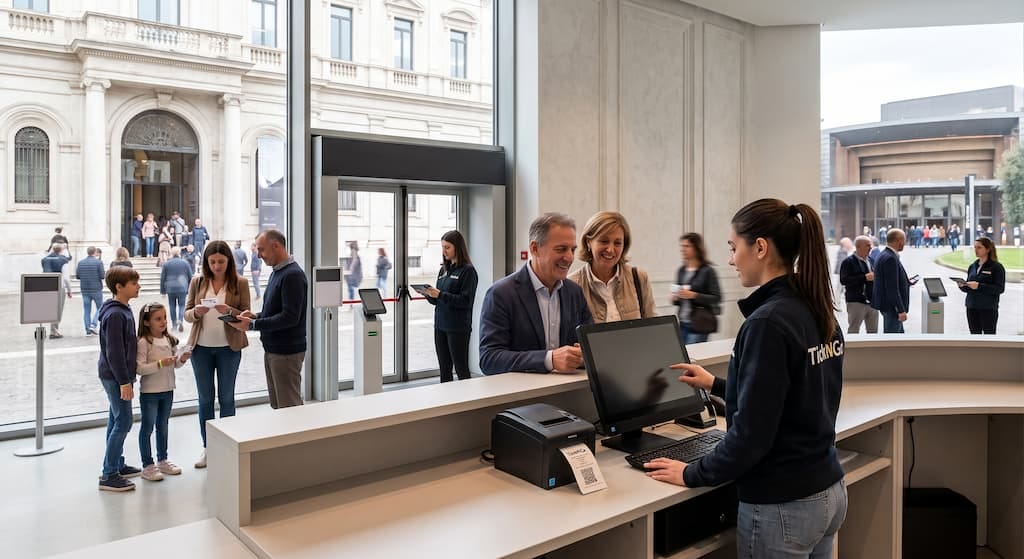
Which access control system should you choose for your museum entrance?

Why access control shapes the museum welcome
A museum visit begins before visitors enter the galleries. It starts in the entrance hall, at the ticket counter or turnstile, when someone checks a ticket and shows the way. This is where visitors form their first impression of the venue, and where staff face the daily challenge of checks, questions and queues. Choosing an access control system is therefore as much about internal organisation as it is about the quality of the welcome.
Think of the first Sunday of the month, when admission is free. By ten o'clock, the courtyard is already full of school groups, tourists with agency vouchers and visitors who booked online the night before, while two members of staff at the counter try to handle everything at once. One missing confirmation email can hold up the queue for several minutes, and within half an hour it stretches out onto the pavement.
Every museum therefore needs to find its own solution. A venue with a spacious entrance hall and a steady stream of visitors needs different tools from a small archaeological site, where arrivals are concentrated into a few hours and there is no room for permanent installations.
Automatic gates, portable readers and handheld devices can be used individually or in combination, and the right solution usually starts with observing what happens at the entrance each morning.
Online, at the kiosk or with a voucher: QR codes validate every ticket
Visitors who buy online, collect a ticket from a self-service kiosk or arrive with a tour operator's voucher may have taken different routes, but admission checks need to be quick and straightforward for everyone.
QR code access control follows a simple principle: every admission ticket has a unique code that the system recognises when scanned. Tickets bought online, issued by a self-service kiosk or linked to an agency voucher therefore all follow the same validation process.
The process is straightforward. The reader scans the code on a smartphone or paper ticket, and the system checks it against the ticketing data, immediately indicating whether admission is authorised.
In practice, QR code access control brings several benefits that staff notice within the first few weeks:
- checks take just a few seconds, which makes a particular difference when several groups arrive together;
- there is no need to distinguish between tickets bought online, issued at the counter or linked to a voucher, because the process is the same for everyone;
- an invalid or previously used code is flagged immediately, so the same ticket cannot admit two people;
- entrance staff no longer need to read printed dates and fares, leaving them free to do what a machine cannot: welcome visitors, explain and offer directions.
The same code is also useful for other services linked to the visit, such as digital audio guides. Once purchased, visitors can use them directly on their smartphones, without collecting and returning physical devices.
For visitors, all this happens behind the scenes. They simply show their phone, while the museum records an admission that will later provide valuable information for planning its work.
Which device is right for your museum?
Once you have chosen QR codes, the next step is deciding how to scan them. The first question concerns the physical entrance: should visitors pass through a gate that opens only after their ticket has been validated, or is it enough for a member of staff to check the ticket with a reader?
In the first case, an automatic gate operates independently. In the second, staff manage the checks using portable or handheld readers.
The table compares the three devices TickNGo offers for museum entrances.
DEVICE | TYPE | STAFF REQUIRED | FEATURES | WHEN TO CHOOSE IT |
|---|---|---|---|---|
sMove Wave | Automatic access gate | No dedicated security personnel required | Advanced locking system; requires a data connection and mains power | Main entrances with high, steady visitor flows |
Door.Gate Pedestal | Up to three readers per operator | One operator supervises up to three readers | Battery-powered device with Wi-Fi; can be positioned wherever needed | Flexible checkpoints that are easy to reposition |
Mobile access control | Handheld reader | One device per operator | Designed for checkpoints where greater flexibility is needed | Organised groups, secondary entrances and temporary events |
There is no need to choose just one technology: the most effective access control system often combines different devices. TickNGo's gates and readers for admission checks work on the same platform, so you can start with what you need today and add devices as visitor numbers grow or a new entrance opens.
Different spaces, different devices: choosing the right solution
A civic museum in a city centre, a historic house and a large archaeological park can have very different visitor management needs. The space available, the number of people to welcome, the entrance layout and, often, the scope for installing new equipment all vary.
Choosing an access control system therefore means considering the venue's characteristics and its daily activities. Some common situations help explain which solutions best meet different needs:
- Civic museums and venues with one main entrance: where visitors arrive steadily throughout the day, an automatic gate such as sMove Wave validates tickets and controls passage without requiring an operator to be present at all times. Staff can spend more time welcoming visitors, providing information and offering assistance.
- Historic houses, palaces and museums in listed buildings: installing a turnstile or a new network connection is not always possible in a protected building. Door.Gate Pedestal runs on battery power and Wi-Fi, can be placed wherever needed and can be repositioned without permanent installations.
- Archaeological parks and outdoor cultural sites: distances are greater, entrances are spread out and the signal can be intermittent in some areas. Handheld and portable readers allow staff to cover several access points at once. Where a satellite connection is provided, the system can continue to operate away from conventional network coverage.
The calendar also changes the picture more than you might expect. A museum that mainly welcomes school groups on weekdays may be overwhelmed on spring weekends or during a major exhibition. An archaeological site that needs several checkpoints in August may need only one during quieter months.
For days outside the usual routine, such as several classes arriving together or an evening opening, Mobile access control lets staff meet visitors in the courtyard, under the cloister or at a side entrance. Being able to add, remove or move devices according to the season helps allocate staff more precisely, without redesigning the entire setup each time.
What admission data tells museum managers
Checking that a ticket is valid is only the visible part of the work. Whoever coordinates the day also needs to know how many visitors are expected, how many have already entered and which time slots are busiest. Staffing, special openings and even the decision to open an extra gallery depend on this information.
When access control is part of the same ticketing platform that manages online sales and self-service kiosks, these figures are available in a single dashboard, updated in real time. Comparing tickets sold with actual admissions reveals peak times and helps staff activate an extra reader before a queue forms. There is no need to wait until Monday or cross-check spreadsheets to review the weekend's figures.
The same monitoring also supports conservation. In smaller galleries or rooms containing fragile works, knowing how many visitors are entering helps prevent overcrowding that affects both visitor comfort and conservation. This is one way in which the digitalisation of cultural venues supports the heritage itself as well as its management.
With TickNGo, access control grows with your museum
Every museum has different needs, and the way it manages admissions can change over time. It is therefore important to have a flexible solution that adapts to the available space, visitor numbers and organisational needs, without replacing devices that are already installed.
TickNGo brings together culture and technology through the collaboration between Aditus, with its experience in managing and enhancing cultural venues, and SKIDATA, part of the ASSA ABLOY Group and a specialist in ticketing and access control technology. The result is a platform that connects online sales, self-service kiosks, access control and reporting.
An access control system can be built one step at a time, starting with what you need today and adding gates or readers as requirements change. No initial investment is required: devices are provided on a free-of-charge loan for use, with no fees.
Would you like to improve admission management at your museum? Tell us how your venue is organised, and together we can identify the combination of gates and readers best suited to your spaces and visitors.