Cultural marketing: what sales and admissions data reveal
What is cultural marketing, and why does data matter?
A temporary exhibition has sold fewer tickets than expected halfway through its run, even though reviews were excellent and the social media campaign seemed to be working. A family workshop is always fully booked on Sunday mornings but almost empty on Saturday afternoons, despite offering exactly the same activities. An evening opening, organised almost as an experiment, ends up attracting more visitors than many other initiatives that season. Anyone working in a museum will recognise situations like these, and understanding what lies behind them is the starting point for any cultural marketing project.
The term refers to the strategies museums and cultural institutions use to understand their audiences, develop an offer that reflects their interests and communicate it in ways that broaden participation, reaching people who rarely visit cultural venues or have never visited one at all.
Much of this work draws on the experience of those who spend every day in the galleries. Staff who welcome groups, answer questions at the ticket office and observe how visitors move among the exhibits gradually build up a valuable understanding of their audiences that is difficult to pass on.
There is another source of information that many museums already have but do not make full use of: the data generated whenever someone buys a ticket or passes through admission control.
What tickets and admissions reveal about visitor habits
Every ticket sold and every admission recorded leaves a trace. Taken together, these records show how and when visitors buy, when attendance rises and which activities are most popular. Often, however, this information remains scattered across separate systems that do not communicate with each other, and bringing it together requires manual work that few museums have time for.
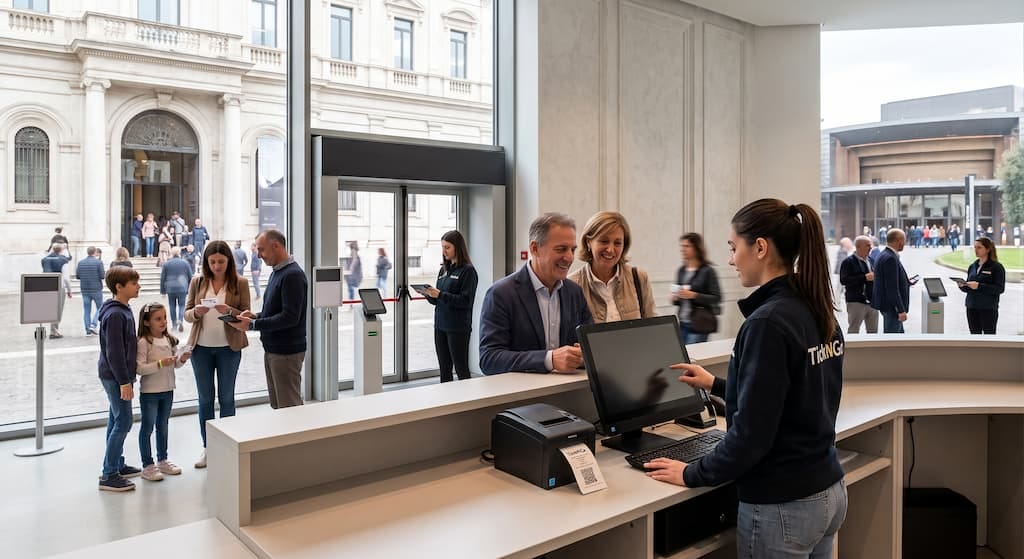
When online ticketing, self-service kiosks and access control are managed through the same platform, the picture becomes much clearer: sales, bookings and admissions feed into a single dashboard updated in real time and can be exported for more detailed analysis. This provides an initial form of customer profiling, based on aggregated data about purchase channels and types of visit, helping museums identify audience groups with different behaviours without having to reconstruct each visitor's individual journey.
Three types of information are particularly useful for guiding decisions about promotion and programming.
- Sales channel. This shows how visitors prefer to buy their tickets, which does not always coincide with the channel through which they discovered the exhibition. If online purchases predominate, it makes sense to focus on booking by smartphone, while a high proportion of on-site sales is a reason to check that online ticket purchasing is easy to find and complete.
- Busy days and times. Peak periods help museums plan their calendars and allocate staff; quieter slots indicate where to schedule themed tours or activities designed for a particular audience.
- Tickets sold and admissions recorded. Comparing the two distinguishes bookings from actual visits and provides a more accurate measure of participation in exhibitions and events.
Together, this information becomes a useful resource for museum communications teams, helping them understand their audiences and plan initiatives and promotional activities around observable behaviour rather than impressions alone.
Different booking patterns, services and channels for schools, families and tour operators
A family looking for something to do on Sunday, a teacher organising a spring school trip and a tour operator bringing three groups into the museum on the same morning have very different expectations. They differ in how far ahead they book, the services they need and the information they want before setting off. A message designed for one audience may mean very little to another.
Effective museum marketing takes these differences into account and develops distinct offers and tones for each audience. When the platform distinguishes between user types and links each one to the services purchased, ticketing data helps museums understand what each category is looking for, as the three most common examples show.
- Schools and school groups. Teachers plan trips well in advance and tend to favour visits combined with educational activities. Tracking the months when bookings are concentrated and the experiences most often requested helps museums shape their offer for the school year and present it to schools when they are choosing their destinations.
- Individual visitors and families. People planning their own visit may buy online several days ahead or decide at the last minute. Knowing when purchases are made, which time slots are preferred and how many visitors add an audio guide or guided tour helps museums decide which activities to highlight at weekends, over long weekends and during school holidays.
- Agencies and tour operators. Organised groups follow their own booking procedures and may arrive with vouchers to exchange for tickets directly on site. Monitoring admissions through these channels shows which partnerships are most active and the seasons when it makes sense to develop dedicated packages.
Depending on the venue, it may also be useful to distinguish residents, cultural associations or participants in specific events, each with their own booking arrangements, fares and dedicated services.
Cultural and destination marketing: putting data to work for museum networks
When an organisation manages several museums, archaeological sites or cultural venues, looking at each location separately means missing an important part of the picture. Each venue has its own audience and offer, but many opportunities only emerge when their performance is compared.
This applies to a network of civic museums, a foundation managing several historic buildings or an archaeological park with separate areas open to visitors. If all locations use the same ticketing and access control platform, sales, admissions, bookings and services feed into shared reporting, making it possible to compare individual venues without losing sight of each one's cultural identity.
This comparison can lead to practical cultural and destination marketing strategies. If one venue is busy in summer while nearby sites attract few visitors, museums can propose routes that connect them or combined tickets that encourage visitors to explore more of the area. Knowing when more organised groups arrive also helps establish partnerships with tour operators, schools and local organisations. Finally, a shared view of the calendar avoids unwanted clashes between venues and gives less well-known locations greater visibility.
Data and culture: finding the balance, one decision at a time
Data becomes particularly useful while an activity is still running and there is room to make adjustments. Tracking sales for a temporary exhibition week by week, for example, makes it possible to check whether bookings are meeting targets and strengthen communications while several weeks remain, rather than discovering the problem after the exhibition has closed.
The same reasoning applies to a reduced fare for university students or any other change introduced during the year. Comparing sales and admissions before and after the change does not, on its own, explain the causes: the season, weather or word of mouth may also play a part. It does, however, quickly show whether something is changing and where to focus further analysis.
No number can replace curatorial decisions. Information gathered through ticketing helps guide promotion and organisation, while the meaning of an exhibition or educational programme remains the responsibility of curators and museum staff, who can nevertheless draw on firmer evidence when assessing the impact of their work. The digital management of cultural venues serves the same purpose, providing tools to understand visitors better while leaving museums free to define their own mission.
From sales to reports: TickNGo tools for museum cultural marketing
Every ticket tells a small part of a museum's story. Bringing those stories together requires tools that connect sales, access control and reporting without forcing staff to gather information from separate sources.
TickNGo was created through the partnership between Aditus and SKIDATA, combining experience in enhancing cultural venues with technological expertise in ticketing and access control systems. It provides museums, archaeological sites and museum networks with a platform that gives cultural marketing a solid foundation:
- Real-time reporting: admissions, sales, bookings and extra services in a single dashboard, with exportable data.
- One shared catalogue: tickets, guided tours, audio guides, educational activities and vouchers, with prices and availability aligned across every channel.
- Features for every audience: dedicated journeys for individual visitors, schools and tour operators, with the option to add further user categories.
- No upfront investment: hardware provided on a free-of-charge loan for use, no recurring fees, and a system that integrates with the software already in use.
Want to understand what your museum's numbers reveal? Tell us how you currently manage ticketing and services, and together we can identify the tools best suited to turning that information into decisions for your audiences.